02 Mar

📖Writing a technical book: what really happens inside a writing session

In the previous posts, I talked about writing metrics and how to schedule writing sessions realistically. In this final article, I want to look at what actually happens inside a writing session — and at what is usually called writer’s block.

I don’t really believe in writer’s block when it comes to technical books. Let me explain why.

A writing session is not just about writing

A working session on a technical book is not limited to producing text. It also includes:

  • reading documentation,
  • researching,
  • writing and testing code,
  • preparing figures,
  • proofreading and integrating feedback.

So even on days when inspiration is low, there is almost always something useful you can — and should — do. When the preparatory work is done, writing becomes much easier. It’s like building a house: once you have a solid blueprint, construction flows.

Remove the pressure to be brilliant

Another major source of blockage is self-judgment. First drafts are not supposed to be good. In her book Bird by Bird, Anne Lamott famously describes them as “shitty first drafts.” She writes:

Almost all good writing begins with terrible first efforts. You need to start somewhere. Start by getting something—anything—down on paper. A friend of mine says that the first draft is the down draft—you just get it down. The second draft is the up draft—you fix it up. You try to say what you have to say more accurately.

Personally, I didn’t hesitate to add jokes just to make myself laugh — sometimes late at night. Some of them even survived the editing process.

How I structure a writing session

I usually start a writing session by rereading and lightly fixing the previous work. This acts as a warm-up.

It helps me get back into the subject and re-establish tone and continuity.

I’ve read authors who explicitly avoid doing this, because they fear spending the entire session rewriting. That’s a valid approach. Each author has to find what works for them.

How to write a technical text

A technical book is not a novel. The rules are different. Readers will not necessarily read a chapter from start to finish. They may skim, jump sections, or come back later looking for a specific idea. That means you have to give them a reason to stay.

First, the opening paragraphs matter a lot. Early on, you should make it clear what the reader will gain by reading the chapter, with explicit statements such as “By the end of this chapter, you will…”.

Second, each meaningful section — and the chapter as a whole — should end with a short summary. This can take the form of a bullet-point list or a table with the key ideas. These summaries serve two purposes:

  • they reinforce what the reader has just learned,
  • and they provide a quick way to refresh one’s memory later, without rereading the entire chapter.

Next, you should avoid dumping huge code listings. Sometimes a short snippet does a much better job. If you do include larger listings, make sure they are properly commented and clearly explained.

In general, allow the reader to breathe.

That means avoiding long, dense pages of text and making sure there are pauses — both visually and mentally. Visually, this can be done with snippets, figures, or short definitions in callout boxes. Mentally, it can be a short, true story drawn from your professional experience and directly linked to what you are explaining. Be careful, though: those stories should remain short. A long anecdote quickly becomes an annoying digression.

Knowing when a text is done

How do you know when a section is finished? For me, it happens in two ways.

First, during rereads, the amount of change decreases. At the beginning, I rewrite entire paragraphs. Then only sentences. Then just words. Eventually, I’m mostly moving commas. When the text stops changing structurally, it feels solidified, and I know it’s done.

Second, it needs to feel right. Sometimes a passage technically makes sense, but something doesn’t flow. As long as that discomfort remains, I keep working — even if I can’t immediately explain why.

That said, there is a danger on the other side. If you rewrite a passage too much, its meaning can start to blur in your mind, like soup. At that point, pausing work on that section is often the right decision.

Let the text rest

Once a chapter is done, I let it rest for a few days. I try to forget about it. When I come back, I do a proofreading session — often on paper. Distance resets perception. Problems that were invisible on screen suddenly stand out.

Conclusion

You can find additional writing advice in the book Writing for Developers: Blogs that get read by Piotr Sarna and Cynthia Dunlop.

If these articles gave you a few practical tools, then it has done its job.

Enough reading. Now it’s time for you to write.
22 Feb

📅Writing a technical book: organizing your writing sessions

In the previous article, I discussed how to calculate writing metrics: writing speed, creative capacity, and writing ratio. Now it’s time to use them to organize actual writing sessions.

But before talking about schedules, one point needs to be absolutely clear: writing sessions must be treated as a priority.


Writing sessions are non-negotiable

Once you decide when and how long you will write, that decision must be respected.

Not after the dishes are done. Not once all pending calls have been handled. Not when everything else is finally quiet. If you wait until all chores are finished, your mind may indeed be at peace — but that moment will rarely arrive.

Writing sessions must come first. When the time comes, you turn your attention fully to the work and deliberately ignore the unfinished tasks waiting for you. This is uncomfortable, but necessary.


Turning metrics into a plan

Once you know your metrics, you can translate them into a concrete plan.

Let’s assume:

  • a creative capacity of two hours on weekdays and four hours on weekends,
  • a writing speed of one page per hour,
  • a writing ratio of 70%
  • a target book length of 350 pages.

You plan to use your full creative capacity of eight hours over the weekend. At one page per hour, that gives:

350 pages ÷ 8 ≈ 44 weeks, or roughly 11 months.

However, once you account for a writing ratio of 70%, the effective output drops:

350 pages ÷ (8 × 0.7) ≈ 62 weeks, or roughly 16 months.

If you want to compensate for the writing ratio, you need to increase the total time spent on the project. By extending each weekend writing session from 4 hours to 5, you reach 10 hours. With a 70% writing ratio, that yields:

350 pages ÷ (10 × 0.7) ≈ 50 weeks, or roughly 12 months.

However, extending sessions beyond does not automatically increase output. At that point, you have already exhausted your creative capacity and almost fully accounted for the writing ratio. Additional hours mostly translate into diminishing returns or lower-quality work, not more pages.

In my case, my writing speed was closer to half a page per hour. Writing only on weekends would have pushed the project to more than 2 years — far too long for a technical book.

The metrics forced a decision: I had to write during the week as well.


Adding weekdays to the schedule

By planning 2 hours each weekday and 4 hours on Saturday and Sunday, I reached 18 hours of writing per week, which translated into roughly 9 pages per week (6 to 7 pages once the writing ratio is applied). That brought the timeline to approximatly a year.

Writing on weekends was easy. Writing on weekdays was not — especially with a family. Some writers wake up early and write before work. I’m not a morning person, so that was never an option. Instead, I planned to write in the evening.

From the moment I got home to bedtime, I had about five and a half hours. Daily chores usually take around two hours, but by concentrating most of them on the weekend, I reduced weekday chores to one and a half hours.

That left:

  • 2 hours to write,
  • 2 hours to rest.

On paper, it looked perfectly balanced. I maintained that rhythm for two months. My writing sessions were immovable. I kept my promise. But slowly, everything else started to deteriorate.

The plan seemed sound. In reality, it exposed a problem metrics alone cannot reveal.


The warning signs

First, daily chores became harder and harder to complete. I reduced them to the bare minimum. Then I started going to sleep later and later just to do… well, not much. Watching videos, I guess. Looking for additional time just for myself. I blamed everything on procrastination: not doing chores, not doing much during my resting time, and being sleep-deprived. Something felt off. But when the most disturbing change happened, I could no longer ignore the problem.

For over twenty years, my free time had been stable: reading books, watching series, or watching documentaries. Slowly, those activities began to feel like too much effort. Picking up a book became exhausting. I replaced them with shorter, easier forms of distraction, such as brief audio stories, and slowly, my hobbies started to drift in unexpected directions — so far from what I was used to that I felt like a different person. That was unsettling. At that point, I had to face the truth: I had pushed myself too far.

I had added 18 hours of work per week — two extra workdays — and I reduced my resting time.

I needed more rest, not less.


Accounting for the human in the process

Most advice about writing a book is about scheduling writing sessions and keeping those appointments. This advice is often written for students working on a thesis, or by people who are their own bosses and can write during working hours. When writing sessions are reducing your rest time, the impact can be significant. To mitigate this, here are my recommendations:

  • Be transparent with your family
    Explain what you are doing, why you may be less available for chores for a while, why you should not be disturbed during writing sessions, and why you may need additional rest during that period.
  • Reduce chores as much as possible
    Avoid writing a book during heavy chore periods such as planning a wedding, moving, or welcoming a newborn. Use every possible shortcut — grocery delivery, teaching your teenagers to clean their rooms (and maybe load the dishwasher), and postponing non-essential tasks for a few months.
  • Plan breaks when working with a publisher
    If you are self-publishing, it is relatively easy to slow down or stop when things become too intense. This is not the case with a publisher. When defining your schedule, explicitly account for breaks and holidays.
  • Take care of yourself
    Make sure you sleep enough, eat properly — especially food that supports sustained cognitive effort — and do some light physical exercise.

One interesting thing to point out is that I did not experience the same kind of exhaustion when I wrote a self-published book in my native language. Quite the opposite, actually. Writing was not depleting my energy; it was recharging my batteries. It didn’t feel like work, but like leisure.

The stress of having a contract, writing in a non-native language, and meeting the higher expectations of a well-known publisher turned what was once leisure into work. Work that I still enjoyed, but that no longer served as a restorative activity.

Just remember that metrics and discipline are necessary, but they are not sufficient. Writing a book is not just a scheduling problem — it’s a human one.


What’s next

In the last post, I’ll talk about writer’s block and what actually happens inside a writing session.

17 Feb

📊Writing a technical book: calculating your writing metrics

Following my first post about finding a book idea and testing it, let’s now look at how to calculate your writing metrics.


Why writing metrics matter

Even with a strong idea, committing to a book is not trivial. And unlike a novel — where an author can afford to spend a decade crafting a chef-d’œuvre — a technical book operates under very different constraints.

If you take too long:

  • your subject may become obsolete,
  • the ecosystem may evolve beyond your initial premise,
  • or another author may publish a similar book before you do.

If you work with a publisher, constraints become even more explicit. You will usually be given a schedule: a certain number of pages per month, a chapter due on a fixed date, or a full manuscript expected within a defined timeframe.

Whether you are self-publishing or working with a publisher, one thing remains true: you cannot plan realistically if you don’t know how fast you write.

That’s where writing metrics come in.


Using exploratory chapters to measure yourself

In the previous post, I recommended testing your idea by writing a few exploratory chapters before committing fully. Those chapters serve another purpose: they allow you to extract three essential metrics:

  • your writing speed
  • your creative capacity
  • your writing ratio

Most people focus on the first. In practice, the second is often more important.


Metric #1: your writing speed

This metric is relatively easy to calculate. Once a writing session is over, take the number of pages (or words) you produced — depending on the metric you prefer — and divide it by the number of hours spent writing.

However, this metric will be different for each of your projects. Each project operates under different constraints and will have a different writing speed. For example:

  • while writing The Art of Code, my speed was about half a page per hour;
  • for another technical book written in my native language, it was almost twice that;
  • story-driven writing tends to be faster.

Technical books are slower to write because they require constant verification, precision, and validation of ideas. Writing in a non-native language slows the process even further.


Metric #2: your creative capacity

This is a metric I didn’t even know existed before I fully committed to writing a book.

During my early sessions, something kept happening. Two or three hours in, my creativity would suddenly drop — sometimes quite brutally. Writing became harder. The result felt flat and less engaging. Everything slowed down, frustration increased, and progress stalled.

After seeing this pattern repeat several times, I had to accept a simple fact:
I have a creative limit of about three hours.

At first, I thought this was low. I had this romantic image of writers spending entire days immersed in their books, writing from dawn to dusk. Compared to that, three hours felt underwhelming.

But after digging a bit deeper, I realized it was actually average.

Creative work is cognitively expensive. Most people can sustain deep creative effort for two to four hours per day. Probably closer to two after an intense workday, and closer to four on a quiet weekend morning.

That creative capacity applies mainly to writing. Other necessary activities, such as researching or writing code, do not tap into it in the same way. This allows you to keep working even once you’re out of creative juice.

While writing, pay attention to your creative capacity. Notice when writing becomes more laborious and your pace starts to slow down, and use that to determine your creative limit.

Why this metric changes everything

Let’s say you’ve measured your writing speed at one page per hour. It might be tempting to plan an eight-hour writing session on a Sunday and expect eight pages. That plan is almost guaranteed to fail if your creative capacity is only four hours. You won’t get eight good pages. You’ll get four solid ones — and four hours of struggle.

This is why creative capacity is a hard constraint. Your schedule must be built around it, not against it.


Metric #3: your writing ratio

When you write a technical book, not all of your working time is spent writing. You will need to:

  • read documentation,
  • explore tools or frameworks,
  • write and test code,
  • build models,
  • integrate feedback from reviewers or editors.

All of this work is necessary. But none of it directly produces pages — and it significantly slows down apparent progress. This is why a third metric matters: your writing ratio. The writing ratio is the percentage of your total working time that is actually spent writing text.

For example, when working with a publisher, only about 70% of my time was spent writing. This means that even with a writing speed of half a page per hour, an average three-hour writing session did not produce one and a half pages, but closer to one page.

Of course, this is not a metric you can calculate on a per-session basis. Some sessions will be entirely dedicated to research or writing code and will produce zero pages. Others will focus almost exclusively on writing and may produce three pages. This is why the writing ratio is the hardest metric to estimate.

My approach is the following:

  • first, calculate writing speed using sessions focused exclusively on writing;
  • then, look at a larger time span — a week or a month — and measure how much was actually written;
  • finally, compare the observed output with what would have been expected based on writing speed alone, and calculate the ratio.

Those three metrics should not become a source of stress. One or two months are enough to get a rough estimate, which you can then refine as the project evolves.

In the next post, I’ll show how to use these metrics to plan realistic writing sessions.

14 Feb

🖊️Writing a technical book: from idea to manuscript

Writing The Art of Code has been an enriching journey. It wasn’t my first experience writing a book, but with this new one, I felt the need not only to share technical insights, but also to share the writing experience itself. That’s why I’ve decided to start a series of blog posts about the process — from idea to manuscript.

This series is for developers who feel the desire to write — whether to share hard-earned experience, explore ideas in depth, or eventually commit to a technical book — and who want a concrete, honest view of what that process actually involves.

The series will cover the following topics:


It all starts with an idea

Everything begins with an idea. Sometimes it feels as if it appears out of nowhere — you wake up with it, or it appears while you’re walking and thinking about something entirely different. But in reality, ideas never emerge from nothing.

An idea is the visible result of invisible preparation.

In technical writing, that preparation is your ongoing technical watch: reading documentation, exploring new frameworks, experimenting with tools, challenging architectural decisions at work, debating design choices with colleagues. It is the slow accumulation of experience, passion and reflection.

Some book ideas require less incubation — for example, writing about a new framework or the latest features of a language. But the ideas behind books that are still discussed years later — like Design Patterns or Accelerate — are rarely spontaneous. They result from deep observation, synthesis, and long-term intellectual reflection.

Cultivating your mind, however, is not enough. You also need time to process. For some, that might mean long walks. For me, that is rarely sufficient. True processing happens at a desk — by giving shape to ideas through writing.

That writing does not need to be public. It does not need to be polished. It does not even need a defined objective. It can be a professional diary, as well as a story or a technical blog post.

The key is to deliberately book time — once or twice a week — to open a document and let your thoughts take form. Whether on paper or on screen, what matters is the act of shaping ideas into language. You don’t need to share it on LinkedIn or publish it on your blog. It can remain entirely private, so there is no pressure to be brilliant. But by consistently creating that space, you open the creative gate of your mind. And that discipline often leads to surprising results.

If you intend to write a book, this habit becomes even more essential. You are not only generating ideas — you are training your craft. You refine your style. You learn to structure arguments. You make sentences flow.


The seed behind The Art of Code

Let me share the story behind my book as an example.

One beautiful autumn day, I sat down intending to write a story. But before starting, I felt the need to vent. Once again, I had heard someone talk about programming as if developers were just “producing code” — as if we were machines outputting lines on demand.

But no two developers write the same code. We don’t model problems the same way. We don’t make the same trade-offs. We don’t express structure, clarity, or elegance in the same way. Code carries judgment, taste, and experience.

And this was even before AI entered the mainstream conversation as our supposed replacement. When that narrative gained momentum, it only amplified the idea that developers are interchangeable — that we merely generate output like a machine.

I wanted to push back against that idea. I wanted to express something I deeply felt: developers are artists, and code can be beautiful.

I wrote that text and later published it as a blog post. It never became a chapter of the book that emerged afterward — but it was the seed.

And then, I decided to challenge myself. If I was claiming that code could be beautiful — something I could clearly feel while programming — could I actually explain it? Could this intuition sustain an entire book?

So I decided to test the idea. As with most of my book projects, I never commit immediately. I write a few exploratory chapters — nothing more. It is like testing the water.

Some ideas survive that phase. Others do not. If, while writing, I feel the idea gaining structure, if I see that there is enough material for a coherent whole, and if — most importantly — the passion to continue is still there, then the project enters the next phase, which I will describe in a future post.


To sum up:

A strong book idea emerges from cultivating your passion for your craft, taking regular time to reflect, and then deliberately testing the concept with a few chapters before committing fully.

In the next posts, I’ll move from ideas to execution: how I measure writing progress, structure sessions around a full-time job, and deal with writer’s block.

21 Dec

⌨️Vibe coding and the slow death of code quality

Vibe coding has become one of the buzzwords of 2025.
When I first heard the term, I found it amusing. I am no longer sure that it is.

Vibe coding describes a way of writing software where prompts replace design and quality concerns. As long as the program runs and produces the expected output, everything is considered fine—regardless of the quality of the code itself. In that sense, even someone who is not a developer can now “code.” I have no doubt that AI can generate working code. Like most professional developers, I use it myself: mainly for boilerplate, documentation, and sometimes to help analyze legacy code or explore solutions to a problem.

AI as a tool, not a substitute

Vibe coding

Used well, AI is a powerful assistant. But it remains an assistant—one that must be supervised. Sometimes it helps you move faster; sometimes it slows you down. It can suggest good solutions, but it can also hallucinate dependencies causing security issues, invent APIs, or generate code that poses significant cybersecurity risks. Supervising all of this takes time, judgment, and experience.

There is also another concern. Using too much AI may slowly erode those very skills. By delegating too much, we risk losing the ability to reason deeply about code over time. I am personally cautious for that reason—not because I am resistant to modern tools, but because I still want to be able to do my job correctly in a few years or when the AI bubble inevitably bursts.

The cost of not looking at the code

Vibe coding is something else entirely. It is the moment when we stop supervising the quality of the code and only validate the result. The output looks correct, tests pass, the demo works—and we move on. The code itself becomes incidental.

But even if we choose not to look at the code itself, one might still argue that it has sufficient quality. However, studies suggest otherwise. They show that AI-generated code produces about 1.7 times more issues, including readability problems, incorrect failure handling, and even security vulnerabilities. Notably, these studies focus on AI used as an assistant, not on fully AI-generated code without supervision, so the results could reasonably be expected to be even worse.

Writing code for durability

For some projects, this may be acceptable. Personal projects, throwaway prototypes, or experiments that will never be touched again can tolerate this approach. But most professional software does not fall into that category. Enterprise systems are expected to evolve, to be secured, to be audited, and to be maintained by humans over long periods of time. In that context, unreadable or poorly structured code is not a minor inconvenience; it is a liability.

Blindly trusting what AI produces can destroy a business. One enterprise learned this the hard way when a vibe-coded application ended up destroying its database. Who is responsible when AI-written code fails?

As long as code is meant to be read, understood, modified, and guaranteed by humans, it cannot be treated as a disposable byproduct. It must be written for humans. And only a human can validate that it is done right. Structure, clarity, intent, and durability still matter—perhaps more than ever in a world where producing code has become easy.

This tension between speed and understanding, between results and responsibility, is not new. But AI makes it impossible to ignore. And it is precisely why we need to rethink what it means to write good code—not just code that works today, but code that lasts.
That question, and what it implies for our craft, is at the heart of The Art of Code.

20 Dec

🍂Why beautiful code still matters in a world of fast software

Beautiful code

I started writing my book, the art of code, in autumn last year. The trees were dressed in a thousand colors—lemon yellow, amber, scarlet—beginning to shed their leaves. Scattered across the ground in a colorful patchwork, they were illuminated by the last soft sunlight of the year. Walking outside awakened the senses, and the mind drifted into a serene, contemplative space. The world was… beautiful.

What makes something beautiful?

We seek beauty within ourselves, whether inner or outer, in our homes, on our walks, in our creations. Whether it’s a landscape, a person, or a work of art, this concept—so difficult to define—feels somehow self-evident. Something beautiful is something that is pleasing to look at or listen to. Observing it triggers an emotion close to happiness, an “aesthetic” feeling.

But emotions are purely subjective, making beauty difficult to define. Standards of beauty evolve over time and often differ from one person to another. These standards reflect our cultural background, as well as our personal tastes. What was beautiful yesterday may not be today; what one finds beautiful might not appeal to someone else. Yet, certain patterns emerge: beauty often evokes balance, symmetry, harmony, and elegance. It represents an ideal, an absolute, a form of perfection.

Can code be beautiful?

Can we apply this concept to code? Can code be “beautiful”? The idea is unsettling; code exists to solve a problem, and in that sense, it’s closer to mathematical reasoning. In our culture, beauty is typically associated with people, landscapes, the arts—painting, music, poetry, literature, sculpture—and even fashion, but rarely with science. A painting can be beautiful, but can we call a mathematical equation beautiful?

And yet, mathematics has always held a place in the study of beauty. Mathematical patterns defining beauty can be found throughout nature and art—for example, the golden ratio, symmetry, fractals, and even the harmonic principles that structure music.

Mathematical beauty is defined by Wikipedia as “the aesthetic pleasure derived from the abstractness, purity, simplicity, depth, or orderliness of mathematics.” Those same words could easily be applied to an algorithm, which is defined by the Cambridge Dictionary as “a set of mathematical instructions or rules.”

In my previous book, I dedicated an entire chapter to “The Art of Coding.” I compare coding to writing a book, crafting a piece of furniture, or painting. Like each of these activities, coding requires a certain expertise, skills hard-won through experience, to produce something useful, readable, and maintainable.

But it’s also something that gives the developer a deep intellectual satisfaction that’s difficult to explain. It took me years to realize that this feeling was triggered by the perfection and elegance of some of the code before me, whether it was my own or that of a peer. That code was magnificent; it was beautiful.

Beauty as a practical discipline to improve quality

Beautiful code is code that elicits a sense of intellectual pleasure and satisfaction. Certainly, code can only reach this level if it follows programming best practices — including indentation and cleanliness — but there’s got to be more. For it to be truly beautiful, there must be a touch of elegance, a simple clarity in its solution.

In The Art of Code, I explore this idea in depth, looking beyond intuition to understand how beauty can emerge in software through deliberate choices. The book offers concrete guidance drawn from real practice, and shows why striving for beautiful code is not an abstract pursuit, but a practical one—leading to systems that are clearer, more resilient, and more satisfying to work with over time.

The art of code

17 Dec

🎨The Art of Code: The surprising power of beauty in software development

The Art of Code

I’m very happy to share a huge milestone for a project I’ve been working on for the past year, and, in some ways, for most of my life as a developer: my book The Art of Code is now available through Manning or Amazon.

The Art of Code is a modern software craftsmanship book that explores how the dimensions of beautiful code—such as simplicity, clarity, expressiveness, storytelling, durability, and purity—can be implemented in practice, and how they lead to code that is easier to understand, safer to refactor, and more resilient over time. It also addresses concerns that matter in real-world enterprise systems, such as concurrency, failure handling, robustness, and sustainability.

In an era where AI is reshaping the landscape of programming, the book deliberately refocuses attention on what remains deeply human in our work: passion, creativity, and beauty.

Most examples use modern Java features, making the book a good fit to get up to speed with recent language evolutions such as records, streams, and pattern matching. That said, the ideas go well beyond any single language.

With Manning’s Early Access Program, the first chapters are already available, and new chapters will be released progressively. Early readers can share feedback, which directly helps shape the final version of the book. I’d genuinely love to hear your thoughts, and you’re more than welcome to discuss the book with me here on this blog as well.

Writing this book has been both challenging and deeply rewarding. I’m very grateful to Manning Publications Co. and to the early reviewers for their support so far.

Thanks for reading, and for any support, feedback, or sharing along the way.

24 Nov

⚖️L’éthique du métier de développeur

L'éthique des développeurs

J’ai eu la chance de pouvoir donner mercredi une conférence à l’Agile Grenoble sur l’éthique dans le métier de développeur.

Pourquoi se questionner sur l’éthique ?

L’éthique est le fondement de nombreuses professions telles que médecin, avocat ou policier. Au cours de mes années de travail, j’ai rarement entendu ce terme dans le cadre de la profession de développeur. L’éthique des développeur.se.s n’est pas un sujet couramment abordé, à part dans quelques conférences. Pourtant les professions disposant d’un grand pouvoir sur les autres doivent avoir une éthique tout aussi grande : « un grand pouvoir implique de grandes responsabilités ».

Certes, a priori le développeur n’a pas le pouvoir de vie et de mort et pourtant… Pourtant, l’informatique est presque dans tous les foyers, elle touche tous les domaines de notre vie moderne. Certains programmes font tourner des machines sur lesquelles reposent les traitements médicaux de patients, certains algorithmes permettent de décider quelles études vous aurez le droit de faire ou de ne pas faire, certaines données privées peuvent être utilisées pour influencer les votes et faire basculer des résultats électoraux. Le code que nous écrivons peut avoir des conséquences positives ou dramatiques sur la vie de ses utilisateurs. Les informations auxquelles nous avons accès sont des intrusions dans le domaine privé et l’utilisation de ses informations par certains logiciels peut parfois se comparer à de la manipulation.

Il est plus difficile de songer à l’éthique quand la personne que l’on risque de blesser est une lointaine statistique, contrairement à des professions comme les médecins, les policiers ou les avocats. Face aux exemples de dérives dans notre métier, il est pourtant essentiel de prendre un moment pour réfléchir à l’éthique de la profession et de souligner son importance, ce que j’ai tenté de faire au cours de cette conférence et dans un chapitre dédié dans le livre le job de dev.

Voilà les slides de la conférence :

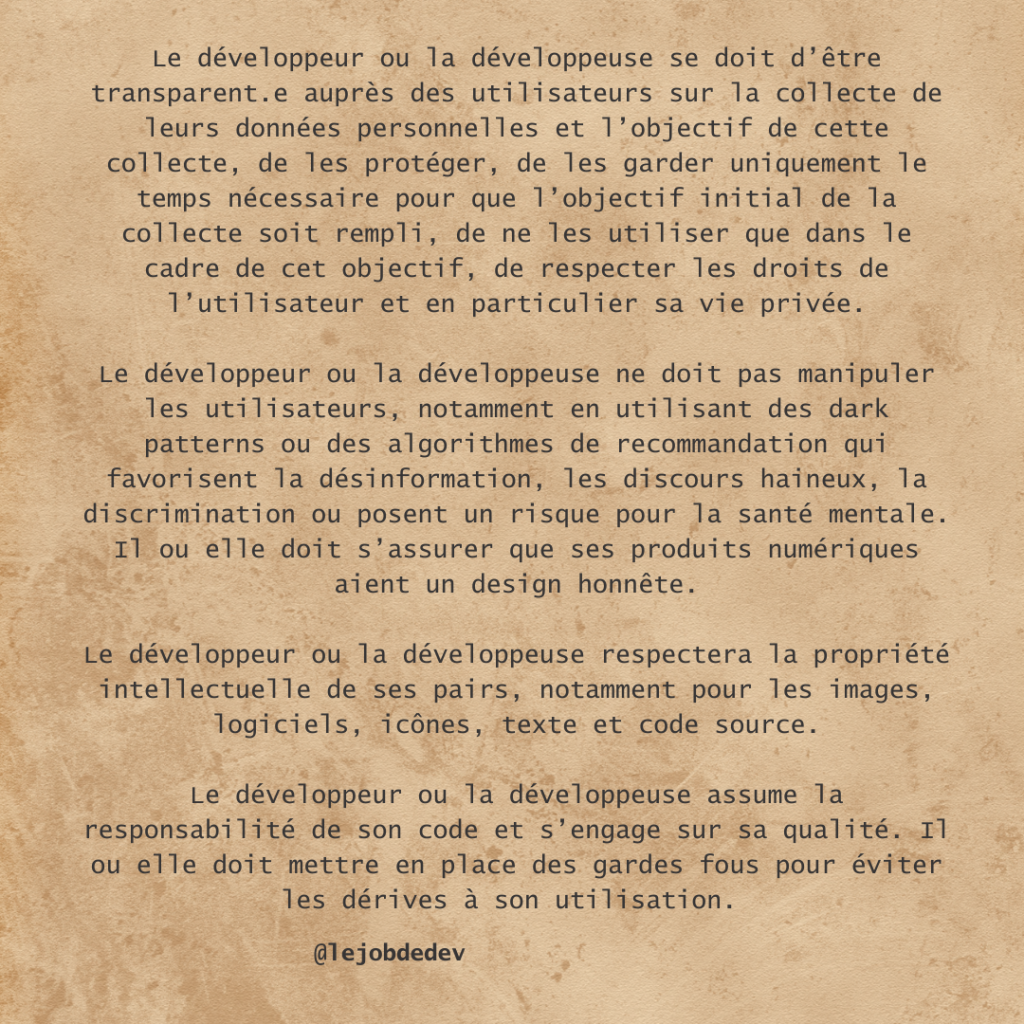
Charte éthique du métier de développeur

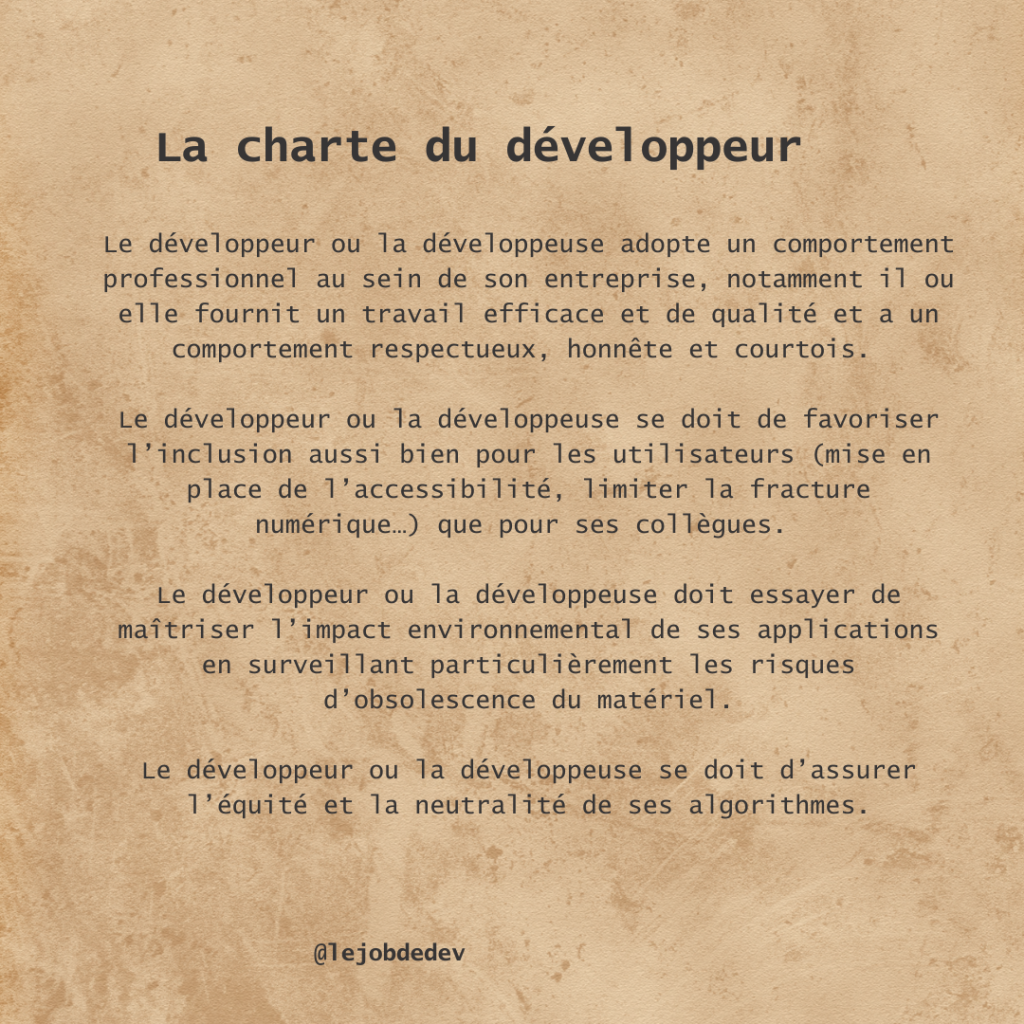
Et enfin j’ai tenté (et tout retour est le bienvenu) d’en tirer une charte éthique pour la profession de développeur.

18 Oct

🖊️Le journal de codeur/codeuse

Journal de codeur

Avez-vous déjà dû désespérément vous creuser la tête pour répondre à votre chef de projet (revenu de congés) sur ce que vous aviez fait à la minute près il y a 3 jours ? Avez-vous déjà essayé de vous rappeler pourquoi vous aviez opté pour une solution technique plutôt qu’une autre, trois mois plus tard, lorsqu’un collègue vient vous demander de justifier le choix bizarre fait dans un bout de code ? Retournez-vous cinquante fois sur internet pour récupérer toujours les mêmes bouts de code dont vous n’arrivez jamais à vous rappeler ? Avez-vous des difficultés pour vous souvenir sur quoi vous travailliez il y a un mois, un an ou plus ? Avez-vous l’impression de progresser difficilement dans vos compétences, ne pas capitaliser sur vos erreurs, des difficultés pour trouver le chemin vers l’expertise ? Si la réponse à l’une de ces questions est positive, c’est que vous avez besoin d’un outil tel que le journal professionnel pour vous appuyer dans votre travail et votre carrière.

Le journal de codeur est l’un des secrets les mieux gardés de la profession. Commencé dès le début de votre carrière, tenu et utilisé de la bonne façon, il fera une énorme différence dans votre progression professionnelle.

J’ai eu la chance de pouvoir partager sur le journal de codeur au Devoxx 2023, la présentation a été filmée et est disponible ci-dessous.

Pour plus de détails, vous pouvez consulter le chapitre “Le journal de codeur” du livre le job de dev.

28 Sep

🕯️La veille technologique

La veille technologique est implicite et nécessaire dans le métier de développeur.se, sans pourtant faire partie de sa description de poste. Cependant, dans la majorité des entreprises, le temps nécessaire est rarement mis à disposition pour la mener à bien pendant son travail, alors que ne pas la faire aura pourtant des répercussions importantes sur sa carrière.

Le terme « veille » signifie rester en éveil, vigilant. La veille technologique, c’est la surveillance des grands changements technologiques qui peuvent impacter une entreprise, mais aussi votre carrière, dans les années à venir. ll est fondamental pour sa carrière et son évolution personnelle d’anticiper les prochains grands virages de la technologie. Sinon, on risque de passer des années à peaufiner un CV avec de l’expérience sur des applications monolithiques pour se retrouver, tout à coup, sur un marché du travail où tout le monde ne parle que de microservices ou encore à être le dernier ou la dernière dans une réunion à savoir ce qui se cache derrière le mot lambda.

La veille technologique

La veille technologique – une nécessité pour sa carrière

Dans ce métier, chacun est le gardien de ses propres compétences et se doit de surveiller les évolutions de son domaine d’expertise afin de toujours rester au courant des dernières nouveautés. Certes, ce n’est pas tout.e seul.e qu’un développeur ou qu’une développeuse pourra influer les grands choix technologiques de son entreprise, mais il ou elle pourra au moins encourager à l’utilisation d’un nouveau framework ou à la montée de version d’un langage et se démarquer comme un profil compétent et innovant. Et quand la grande vague du changement arrivera, et que tout le monde se mettra à parler microservices, conteneurs, cloud ou IA, il ou elle ne sera pas pris.e au dépourvu et sera dans les premiers/premières à postuler sur ces projets aux technologies croustillantes. Connaître les secrets de la veille technologique est un indispensable du métier de développeur.

Ceux qui auront pris de l’avance feront preuve d’une grande rapidité d’adaptation qui favorisera leur carrière. Les autres resteront en arrière, sur les projets aux vieilles technologies et code legacy, sans valeur ajoutée pour leur CV.

Se bloquer du temps

Combien de temps consacrer à sa veille technologique ? De mon point de vue, une moyenne de 5 minutes par jour du lundi au vendredi est déjà un bon début. Avec 5 ou 6 minutes par jour, cela représente déjà 30 minutes par semaine, 2 h par mois, 24 h par an. Il existe des entreprises qui connaissent l’importance de la veille technologique et permettent à leurs développeur.se.s une demi-journée par semaine, soit environ 4 h de veille techno hebdomadaire, le rêve absolu… qui est l’exception plutôt que la règle. Donc entre 1 à 2 h par mois, c’est déjà une très bonne cible pour débuter.

Quelle que soit la réserve de temps que vous vous mettez de côté, il faut passer un véritable contrat avec vous-même, un engagement, de l’utiliser pour votre veille techno. Gardez en tête l’importance de cet objectif, la veille technologique est au cœur de ce métier sans cesse changeant.

Etablir sa liste de sources et prendre des notes

Papier, podcast, vidéo, blogs, conférences… Le choix des sources pour alimenter votre veille techno est la première étape cruciale. Pour plus de détails sur les sources possibles, vous pouvez consulter le chapitre “Veille technologique” du livre le job de dev.

Stockez votre liste de lecture ou visionnage dans un outil approprié. Ajoutez la date de récolte ainsi qu’une note rapide pour indiquer ce qui a piqué votre intérêt. Lorsque vous la parcourrez, pour trouver votre lecture ou visionnage du jour, il sera ainsi plus facile de prioriser et éventuellement de supprimer une récolte trop ancienne ou qui a perdu son intérêt initial.

Une fois l’article consulté ou la vidéo vue, comment en tirer le maximum le plus longtemps possible ? Vous rappelez-vous vos lectures d’articles d’il y a un an, un mois voire même une semaine ? Pour que la veille technologique soit efficace, il est indispensable de l’associer à une prise de notes. Relire les quelques lignes de vos notes doit être suffisant pour rafraîchir votre mémoire. Sans cette prise de notes, le temps passé à cette lecture ou visionnage sera certainement perdu dans quelques jours, au mieux quelques semaines. N’oubliez pas d’attacher la source à votre note pour pouvoir la relire ou revoir si besoin, ainsi que l’auteur.trice. Nourrissez votre future veille technologique en décidant si l’auteur.trice ou conférencier.ère semble suffisamment intéressant.e et si c’est le cas, trouvez-le ou la sur son réseau social pour l’ajouter à vos contacts.

Mise en pratique

Après avoir dégrossi les nouvelles tendances, les nouveaux frameworks ou langages, vient le moment où vous aurez repéré celui qui vous semble vraiment prometteur et pour lequel vous avez envie d’aller plus loin. Jusqu’à présent, vous plongiez un doigt dans la piscine pour tester la température, il est temps d’y plonger: formation, projet personnel, participation à un projet open source, tutoriel…

Si vous mettez en place votre veille techno, vous ne serez plus surpris par les nouvelles tendances technologiques. Les entreprises ne sont pas des « early adopters ». Une technologie n’y arrivera qu’après avoir atteint un bon degré de maturité et de stabilité.